


 289 322

289
MASONS SUPPLY COMPANY
Oregon (800) 537-3407 ♦ Washington (800) 537-6216
Clackamas | Eugene | West Eugene | Hillsboro | Medford | Portland | Salem | Wilsonville | Ridgefield | Seattle | Tacoma | Woodinville
M A S C O . N E T
GENERAL & TECH INFO
CHARTS
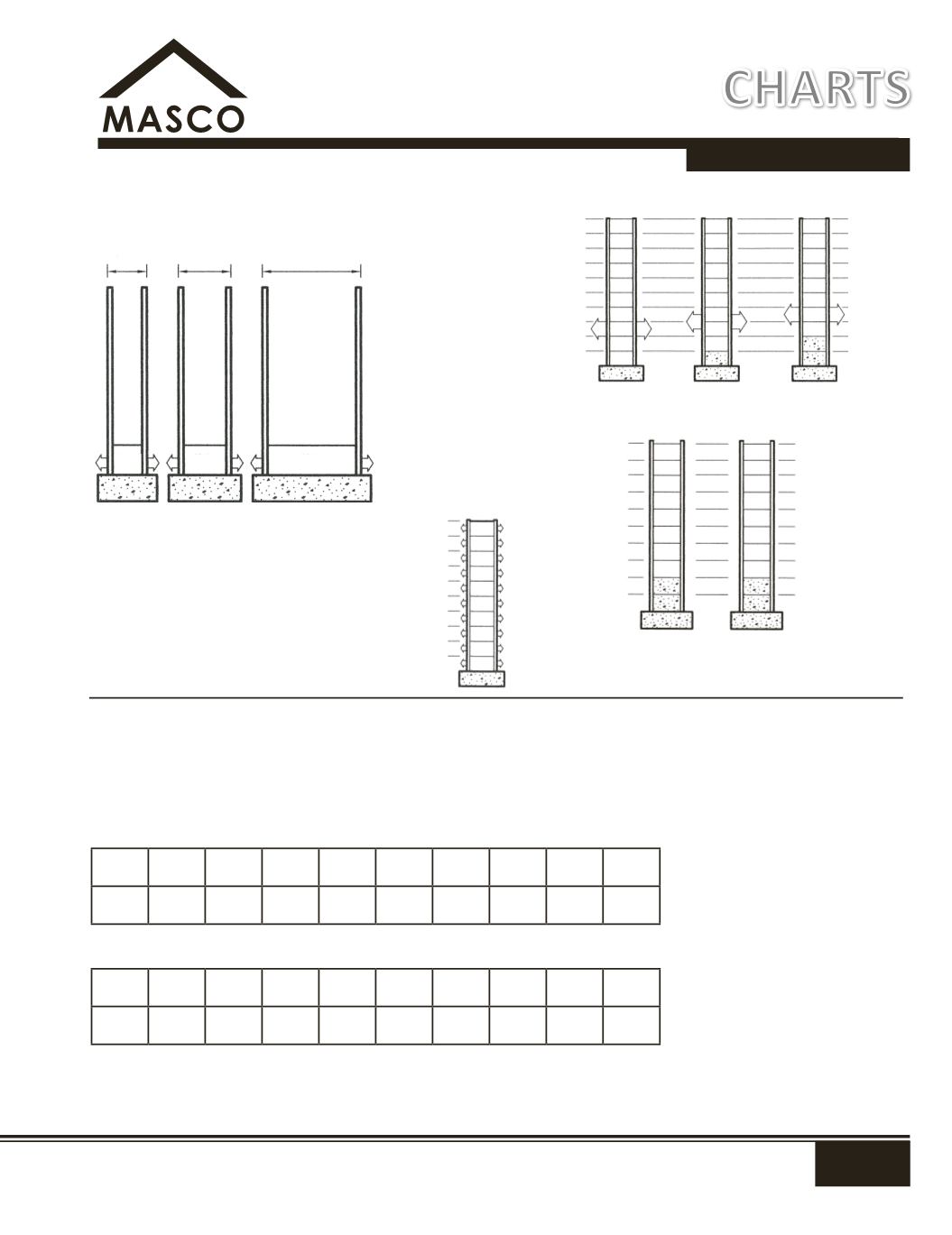
Fluid or plastic concrete exerts the same side pressure on
forms regardless of their width.
As you add more fluid or plastic concrete to forms, the
pressure will build up toward the bottom at about the rate of
150 pounds per foot of depth. This will be true as long as all
concrete remains in a plastic state.
Example:
Eight feet of fluid or plastic concrete bears on the
bottom foot of forms with a pressure of 8x150 pounds or 1200
pounds per square foot.
Slab Formwork Design Loads
The loadings used in the designs of slab formwork consists of a dead load and a live load. The weight of the formwork plus the concrete is considered
dead load while the live load is made up of the with of workers, equipment, material storage and other like items which is supported by the formwork.
The tables below tabulate design loads based on the concrete weight for the thickness indicated, and includes 10 pounds per square foot for the
weight of forms and a live load of 50 to 75 pounds per square foot as indicated. A live of load of 75 pound per square foot is generally used when
motorized carts are used to transport concrete during the placing operation.
For a complete explanation of general objectives in formwork design, planning, materials and accessories, loads and pressures, design tables and much
more, it is recommended that a copy of ACI publication SP-4 "Formwork for Concrete" be obtained. The current edition is available from American
Concrete Institute. PO Box 9094, Farmington Hills, MI 48333.
Points To Remember
2"
4"
6"
8"
10"
12"
14
16"
18"
20"
100
110
135
160
185
210
235
260
285
310
2"
4"
6"
8"
10"
12"
14
16"
18"
20"
125*
135
160
185
210
235
260
285
310
335
Slab Formwork Design Load for Uniform Slab Thickness
(Includes 50 psf Live Load)
Pounds per Square Foot for Indicated Thickness
(Includes 75 psf Live Load)
Pounds per Square Foot for Indicated Thickness
Note: Chart is based on a concrete weight of 150 pounds per cubic foot.
* ACI 347 recommends a minimum 100 psf for form design or 125 psf if motorized carts are used.
Concrete cures and gains strength faster with an increase in
temperature.
Example: At 21
o
C (70
o
F), concrete sets in approximately 1
¼
hour.
At 4.5
o
C (40
o
F) concrete will set up in about 1
¾
hour.
Plastic concrete exerts the same pressure on forms
regardless of their width.
(6')
(12')
(24')
(150 lbs)
(150 lbs)
(150 lbs)
Feet
PSF
KPa
10'
7'
9'
8'
6'
5'
4'
3'
2'
1'
68
136
204
272
340
408
476
544
680
748
150
300
450
600
750
900
1050
1200
1350
1500
1¾ hr
1¼ hr
4.5
o
C (40
o
F)
21
o
C (70
o
F)
Feet
10'
9'
8'
7'
6'
5'
4'
3'
2'
1'
As concrete hardens, lateral pressure on forms decreases.
Concrete in
plastic state
Once bottom
foot is cured
Once second foot of
concrete is cured
PSF
150
300
450
600
750
900
1050
1200
1350
1500
136
68
204
272
340
408
476
544
680
748
150
300
450
600
750
900
1050
1200
1350
136
68
204
272
340
408
476
544
680
748
150
300
450
600
750
900
1050
1200
PSF
PSF
KPa
KPa
Feet
10'
9'
8'
7'
6'
5'
4'
3'
2'
1'