


 287 322

287
MASONS SUPPLY COMPANY
Oregon (800) 537-3407 ♦ Washington (800) 537-6216
Clackamas | Eugene | West Eugene | Hillsboro | Medford | Portland | Salem | Wilsonville | Ridgefield | Seattle | Tacoma | Woodinville
M A S C O . N E T
GENERAL & TECH INFO
Vibration is more about Quality
than it is about Quantity
• Over-vibration can cause
honeycombing rather than
eliminating it.
• Under vibrating concrete can
cause honeycombing in low slump
concrete.
• High slump concrete (7-9 inches)
requires very little vibration. 'Wet'
Concrete and SCC (9 inches
and higher) usually requires no
vibration.
• Over vibration can cause the
concrete to lose entrained air,
sometimes as much as one half of
the air content.
• When placing concrete in lifts, be
sure to penetrate previous layer
with vibrator in order to protect
against cold joints.
• Use as much vertical angle as
possible to maximize effect.
• Using the vibrator as a placement
tool instead of a consolidation tool
can result in sand streaks and an
inconsistent surface.
CONCRETE TIPS
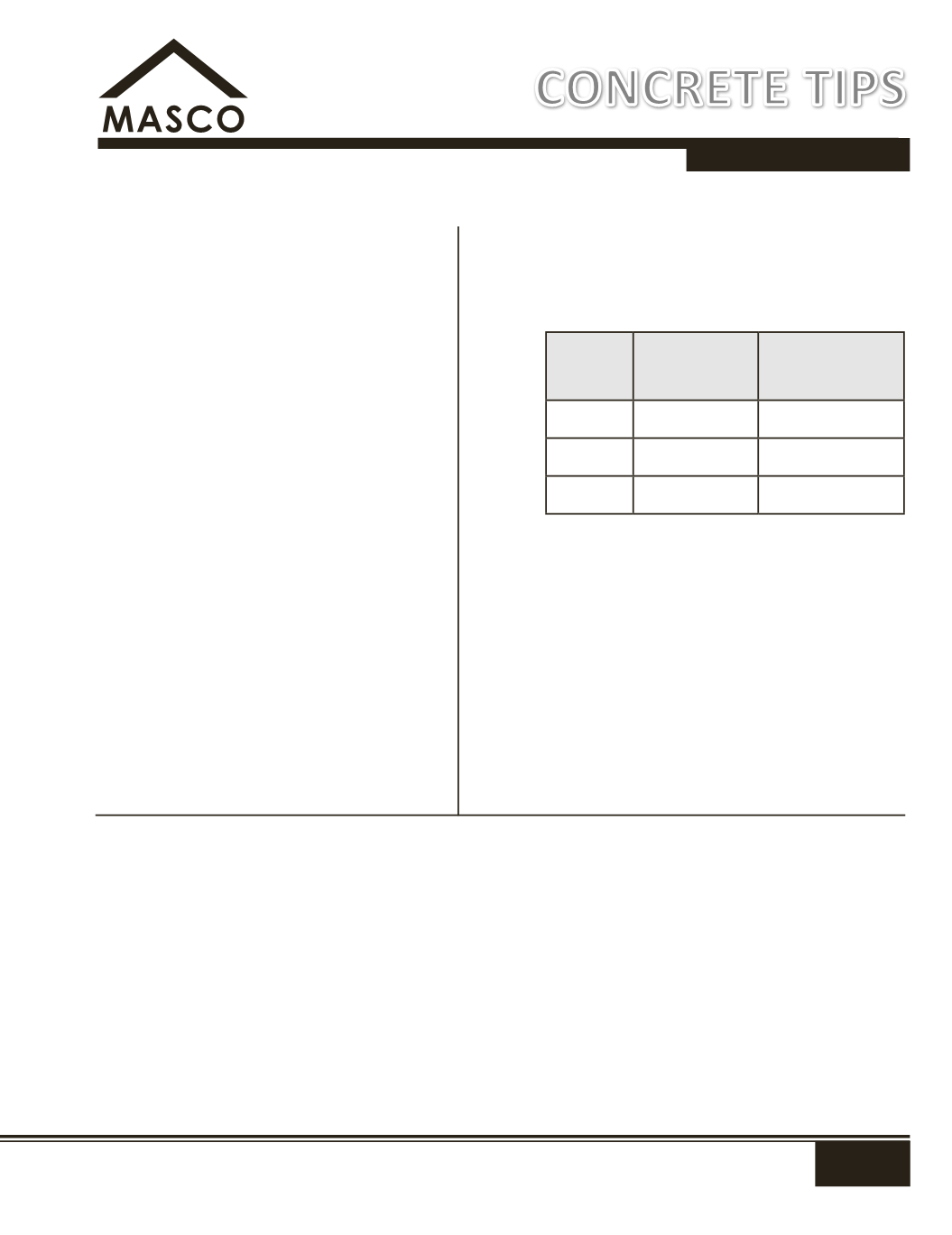
Jointing Guidelines
Code Requirements for Residential Concrete
(ACI 332) specifying maximum contraction
spacing for slabs on grade without steel.
Slab
Thickness
(in)
Maximum
Aggregate Size
less than 3/4 in
Maximum
Aggregate Size
3/4 in and larger
3.5
8 ft
10 ft
4.5
10 ft
13 ft
5.5
12 ft
15 ft
• Saw-cutting should be performed before
the concrete starts to cool and as soon
as the concrete surface is firm enough
not be torn or damaged by the blade.
If sawing is delayed, the concrete can
crack randomly before it is cut.
• Saw-cutting performed too early in the
slab curing process can result in pulling
out of the aggregate.
• Saw cut depths should be a minimum of
1 in and preferably 1/4 to 1/3 of the slab
depth where practical.
Proper curing can make or break
the job
Why Cure?
Improper curing can reduce the designed
concrete strength as much as 50%.
A properly cured concrete will have fewer
pores in the surface where water can enter
and freeze (and crack / scale).
Cured concrete will, in general, crack
less, have reduced or no dusting, be more
durable and achieve increased wear and
abrasion resistance.
Curing Methods
• Membrane curing compounds
• Moist / water cure (concrete is kept wet)
• Wet curing blankets
• Soaked burlap
• Plastic sheets
• 7 Day ponding
When placing concrete in temperatures colder
than 70°F, curing times should be increased to
protect concrete longer as strength develops
more slowly at colder temperatures.